

92% of Punjab Mothers Breastfeed, But 72% Delay First Feed for Five Hours or More: Gallup Analysis
Tuesday, 17 November 2026
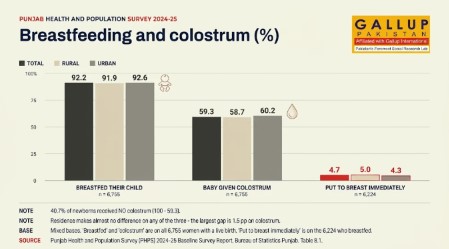
Punjab Health Survey exposes major gaps in newborn feeding practices as only 4.7% of mothers initiate breastfeeding immediately after delivery, 40.7% of babies miss vital first milk and 88% of mothers stop breastfeeding by six months
Hamid Khan Wazir
ISLAMABAD: Despite breastfeeding being widely practised across Punjab, a significant gap in timely initiation and continued breastfeeding is putting the spotlight on newborn feeding practices, with a new analysis revealing that nearly three-quarters of mothers wait at least five hours after delivery before breastfeeding their babies.
According to an analysis by Gallup Pakistan of the Punjab Health and Population Survey (PHPS) 2024-25, 92.2 per cent of mothers breastfed their last-born child, but only 4.7 per cent initiated breastfeeding immediately after delivery, while 71.8 per cent waited five hours or longer.
The findings, based on 6,755 women who had a live birth in the three years preceding the survey, highlight a striking contrast between the widespread practice of breastfeeding and delays in providing newborns with their first feed.
The World Health Organization (WHO) and UNICEF recommend initiating breastfeeding within the first hour of birth, when early feeding provides important nutritional and protective benefits to newborns. However, the survey indicates that breastfeeding initiation remains considerably delayed for a large proportion of mothers in Punjab.
A further 12.6 per cent of mothers began breastfeeding within one to two hours, while 10.5 per cent initiated it within three to four hours. Overall, 82.3 per cent had not started breastfeeding within the first three hours after delivery.
The findings also reveal shortcomings in the provision of colostrum, commonly known as the first milk produced after childbirth and rich in antibodies and essential nutrients. Only 59.3 per cent of newborns received colostrum, meaning 40.7 per cent missed out on this important early source of nutrition and immune protection.
The rural-urban difference in breastfeeding rates was relatively small, with 91.9 per cent of rural mothers and 92.6 per cent of urban mothers breastfeeding their last-born child. Similarly, colostrum was given to 58.7 per cent of newborns in rural areas, compared with 60.2 per cent in urban areas.
Breastfeeding Ends Too Early
The survey also raises concerns over the duration of breastfeeding, showing that most mothers discontinue the practice much earlier than recommended by international health guidelines.
Nearly one in four mothers, or 24.2 per cent, breastfed for less than one month, while another 17.2 per cent stopped between one and three months. Combined, 41.4 per cent discontinued breastfeeding before their babies reached four months.
Although 46.6 per cent continued breastfeeding for four to six months, only 11.9 per cent maintained the practice for seven months or longer. Overall, 88 per cent of mothers had stopped breastfeeding by six months.
The WHO recommends exclusive breastfeeding for the first six months of life, followed by the introduction of appropriate complementary foods while continuing breastfeeding up to two years or beyond.
The survey further found that 61.7 per cent of mothers introduced complementary foods when their children were between four and six months old, including 59.9 per cent in rural areas and 64.3 per cent in urban areas.
Three in Four Newborns Given Other Liquids
Another significant finding concerns the introduction of liquids other than breast milk during the first three days after birth.
According to the analysis, 77 per cent of newborns in Punjab were given liquids other than breast milk during this crucial period. The practice was reported among 76.2 per cent of rural mothers and 78.2 per cent of urban mothers.
Among mothers who introduced other liquids, milk other than breast milk was the most commonly reported, at 49.3 per cent, followed by honey at 37.4 per cent, ghutti at 30.1 per cent and infant formula at 29 per cent.
The survey noted that ghutti, traditionally given to newborns for various perceived health benefits, is described as a mild laxative and is not medically recommended.
The figures also show differences in feeding practices between rural and urban households. Milk other than breast milk was more commonly reported in rural areas, at 54.6 per cent, compared with 40.9 per cent in urban areas. In contrast, infant formula was more frequently reported in urban areas, at 37.7 per cent, against 23.6 per cent in rural areas.
Gallup Pakistan noted that mothers who introduced other liquids reported giving an average of approximately 1.7 different types, meaning the categories overlap and should not be interpreted as mutually exclusive.
Rural-Urban Divide Remains Narrow
A notable aspect of the findings is the relatively small difference between rural and urban Punjab across several key breastfeeding indicators.
While breastfeeding rates stood at 91.9 per cent in rural areas and 92.6 per cent in urban centres, the proportion of mothers introducing other liquids during the first three days was also broadly similar.
The findings suggest that delayed breastfeeding initiation, early discontinuation and the introduction of other liquids are widespread practices across the province rather than challenges confined to a particular residential setting.
The analysis draws on Tables 8.1, 8.2 and 8.3 of Chapter 8 of the Punjab Health and Population Survey 2024-25 Baseline Survey Report. Gallup Pakistan clarified that the analysis covers provincial and rural-urban comparisons, with no district-level or educational breakdown available for these breastfeeding indicators.
The PHPS 2024-25 was conducted by the Bureau of Statistics Punjab in collaboration with the Population Council and Population Center Pakistan. Fieldwork took place between November 2024 and February 2025, covering 24,540 households across all 36 districts of Punjab.
The survey provides baseline data on maternal and child health, nutrition, family planning, immunisation and other population-related indicators.
The latest findings underline the importance of strengthening maternal health awareness, promoting early breastfeeding initiation, encouraging the provision of colostrum and supporting mothers to continue breastfeeding alongside complementary foods in line with WHO recommendations.


More from Pakistan News



Comments
No comments yet. Be the first to comment!
Leave a Comment